
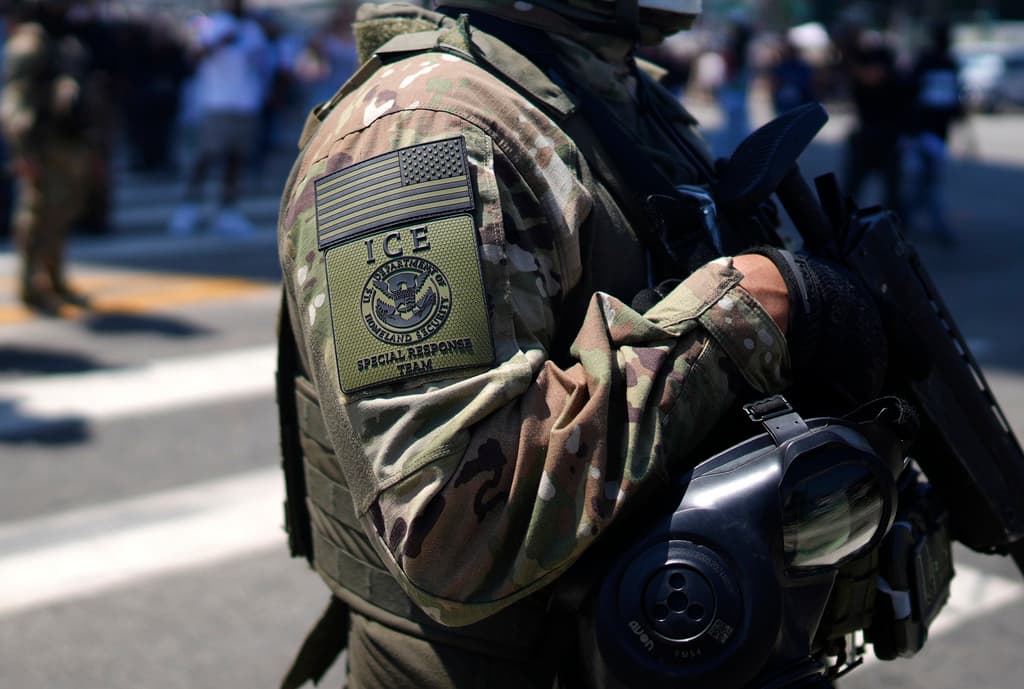
Lawyers for the federal government on Wednesday asked a skeptical federal judge in Denver for patience as immigration agents try to comply with federal laws limiting the scope of warrantless arrests for undocumented immigrants.
Assistant U.S. attorneys acknowledged that Immigration and Customs Enforcement agents aren’t fully trained compared to their predecessors — in Colorado or nationally. They acknowledged that warrants filled out by agents during or after arrests in the field — particularly among people they just happen to come across — are riddled with mistakes and inconsistencies, and don’t comply with federal law. They even acknowledged that full-blown warrantless arrests are still happening among people ICE agents aren’t targeting, even since a preliminary injunction was issued by U.S. District Judge R. Brooke Jackson to ban that.
“We’re making serious progress to comply, and we’re working towards correcting … violations,” said assistant United States Attorney Nick Deuschle.
Jackson cut him off.
“When the court issues an order, it is to be followed, not just we’ll try to be a little better and our trend will be good,” he said.
Deuschle said he agreed, but then he added, “There is not willful widespread noncompliance. We really are working hard to comply.”
At issue is how ICE has been conducting arrests and detention in Colorado since the start of the second Trump administration - particularly for people who aren’t considered “targets” but who officers just come across in the course of regular patrols and visits to places like construction sites.
Congress allows ICE agents to make warrantless arrests in extremely limited circumstances: they must have probable cause that a person is in violation of immigration laws and probable cause that the person would be likely to escape before they could go get a warrant.
The ACLU of Colorado sued the federal government last year, saying it had dozens of plaintiffs who had been arrested and detained without warrants and without the proper flight risk assessments.
Jackson agreed in November and issued a preliminary injunction requiring ICE to start following the law. Jackson agreed to bring everyone back to court this week because the ACLU accused the federal government of not following his order.
Gregory Davies, who is the assistant field director in Colorado, told Jackson on Wednesday that for years, ICE agents here conducted “targeted enforcement operations, which means they had packets of people they were looking for. That typically included people with criminal records or pending criminal charges, and warrants were already prepared for those people before they went out and looked for them.
Then, when Trump took office and leadership at the Department of Homeland Security changed, and the number of ICE agents grew across the country, including Colorado, where they went from about 60 people to more than 150 now, priorities and top-down dictates became more confusing, Davies said.
That means the new agents, many of whom received about half the training that Davies did more than a decade ago when he was a new deportation officer, were charged at times with goals of how many arrests they were supposed to conduct per day, they were told to pick up “collaterals” - people they just come across in the course of patrols, not people for whom they were looking.
Davies said Wednesday that all of the changes had “taken its toll” on the office and they were trying to get back to targeted enforcement. He also said that he believed in warrants and he was attempting to train his people, but he acknowledged the training started a few months after the preliminary injunction and has only happened for about 15 people so far.
Davies also said four people had been taken off patrol duties for poor performance.
He said that two officers were moved from field work to desk work after they were involved in some warrantless arrests in Minturn. An immigrant rights group said that a few of the abandoned cars of the people they detained had Ace of Spades cards left on them with the address for ICE’s detention center on them. Ace of Spades cards have a long racist history and the incident is still under investigation, Davies said.
Jackson, on Wednesday, seemed unimpressed by the three ICE agents who testified in court this week. The three men, who were granted anonymity through pseudonyms at the request of the federal government, gave varying explanations and confused answers about what the court order even was, what the rules were around warrantless arrests, under what circumstances they are allowed to make them and even whether they had ever read an email from their supervisors or ICE headquarters.
“They didn’t have a clue!” Jackson told an assistant U.S. attorney on Wednesday. “They didn’t know about the policy pronouncements that have been issued by ICE, they haven’t received serious training, they didn’t have the ability to answer (the ACLU’s) questions.”
Deuschle acknowledged that the confusion and general low performance on the job for two of the ICE officers who testified meant they were taken off street duty.
“I would agree that they weren’t shining examples,” Deuschle said.
“You can’t generalize from those three guys one way or the other,” Jackson said. “They didn’t get the training. Either they didn’t get it, period, or they didn’t GET it.”
During court testimony on Tuesday, local ICE supervisors told Jackson they were trying to adhere to his preliminary injunction order in November that requires they follow proper procedures when conducting warrantless arrests for undocumented people.
But then, Washington, D.C., as recently as January 2026, has been giving conflicting guidance that it’s allowed in a number of circumstances.
Before adjourning on Wednesday, Jackson took the scope of Trump’s immigration enforcement surge in.
“We have … 120 new officers here, it’s an extraordinary thing that’s happening in this country, including what’s happening in this state,” he said. “It’s an unprecedented thing. I can’t assume these guys are getting trained or understand when we haven’t seen one (arrest warrant) that was filled out properly.”
Jackson is expected to rule soon on whether the Department of Homeland Security is in violation of his November order and, if so, what remedies he will take to get them into compliance.
Jackson speculated in court on Wednesday that the bigger issue about whether so-called “field warrants” - a term ICE uses when they issue a warrant after they’ve detained someone in handcuffs - are legal under Congressional authority will likely be taken up by a higher court on a different day.
- Confusion reigns among Colorado ICE officers as supervisors give and get conflicting instructions on detaining immigrants
- Immigration lawyers and Homeland Security continue their fight over warrants and detentions
- Exasperated Colorado federal judge orders Trump administration back to court on warrantless ICE arrests